

No. 4 - Let's Go Nuclear
US French relations, Hypersonic missiles, Governing space, Nuclear power and the future of Fusion
Welcome back! After much travel in the last month I’m in San Francisco packing up my apartment of the last 6 years to move to Venice, LA. It was a good run here. In this Sunday edition, I offer a suggestion for the State Department. Then some thoughts on recent space news - hypersonic missiles, space debris, and replacing the ISS. The main focus is on nuclear power, which outlines the current state of affairs. I detail the importance yet decline of Nuclear energy, and a recent breakthrough in Fusion that may bring us one step closer to rapid decarbonization.
The French Dispatch
International Affairs
A recent trip to Paris reminded me of the unique importance of interacting with people abroad. I had conversations with our French counterparts on everything from cryptocurrency (shitcoins especially) to vaccine mandates. It has been awhile since either of us has had a chance to swap thoughts in such an organic way. The wine was flowing, and hearing the French perspective on the things we’ve been in isolation for the last 18 months was a breath of fresh air.
Talking to strangers has its benefits. Engaging with new people, in a casual and meaningful way, is part of what makes the world go round. How can we encourage people traveling to chop it up with other cultures? I say we let people expense a small part of their travel to the State Department. I like to believe I did a small part for US-French relations with a few bottles of wine. The State Department has a $58.5 billion dollar budget. If we took 20% of that $58b and dispersed it across the 45 million or so Americans that travel abroad yearly, we’d have $220 bucks to provide as a benefit for US citizens who make an effort to get to know other countrymen abroad. This idea has some holes - we’d need some kind of honor system and who knows how you define "effort”, but I like it. It would also help me recover financially from all that French wine.
Governing Space, Missiles, and Debris
General Mark Milley, the Chairman of the Joint Chiefs, confirmed this past week that China tested a hypersonic weapon. My favorite General called it a “significant technological event” and “very concerning”.
Hypersonic flight is promising for future aviation. Fly into LAX these days and you’ll see a United Airlines billboard advertising hypersonic passenger flights by 2029 (which will be 2.5-3x faster than flights now). 60 Minutes just did a whole piece on hypersonic flight focused on the team at Boeing who is working on turning the Sonic boom into a sonic “thump”. Meanwhile, China is charging forward with hypersonic technology in weapons. Recently, a Chinese rocket that had begun to orbit earth, unexpectedly redirected itself down back towards the earth, before crashing into the ground.
The weapon they tested uses a detachable glider attached to a rocket which can release before getting to orbit and re-enters the atmosphere very quickly, making it hard to detect on radar. The advantage of an orbital weapon is that it can go over the South Pole and reach America from a direction where the country has neither ground-based radar nor perfect coverage from infra-red satellites that can identify rocket engines. The US has strong ground based monitoring capabilities over the north pole thanks to Alaska. Most of the radar systems we built for ballistic missile monitoring have been configured to communicate with new satellite constellations.
I wrote about the Space Fence monitoring system in Newsletter 2 and it seems more advanced monitoring capabilities may already be needed. Brian Weedon from the Secure World Foundation spoke last week on this Main Engine Cutoff podcast suggesting that we build a second Space Fence monitoring system as debris continues to crowd Earth’s lower earth orbit. This was in part due to Russia recently tested a laser weapon on a defunct satellite creating ~1500 pieces of debris that now need to be monitored and avoided.
I believe the US has redundant capabilities for monitoring hypersonic weapons. Debris monitoring can also be improved. But both of these recent events show how complicated governing space is becoming with new technologies. There is a governing body for space incidents called the ITU, it will be interesting to see how countries handle these situations moving forward. If a collision happens with some of those pieces of debris, will we be holding Russia accountable? How will we coordinate on debris removal and avoidance? The international relations challenges alone will certainly lead to more discussions among the big 3 in space - Russia, China, and the US, each of whom are responsible for about a third of the debris in space. For more details on this I highly recommend the episode of main engine cutoff.
Private Space Stations
Unlocking the future of biology from space
In 2027 the International Space Station will use it’s thrusters to guide itself to its intended demise somewhere in the Pacific Ocean. It will mark the end of life for the most expensive object humans have ever built (est. ~$100b dollars). It will also be the beginning of a new era of space. With no plans to replace the ISS, countries are relying on private industry to lead the future of space stations. NASA will follow a similar model to the one they’ve pioneered with SpaceX - using private companies to drive forward space progress (a la SpaceX).
It will be fascinating to see what private space stations will be able to do that we can’t do here on earth. There is talk of how pharma and biotechnological work in space, including 3D printing organs and development of stem-cell therapies may actually be easier due to the lack of gravity1. On earth, biological structures must often be contained as a viscous gel to prevent them from falling apart. In orbit, nothing drips. Cell cultures benefit from microgravity because their components remain in suspension in their nutrient fluids, rather than tending to settle out, as happens on earth in fermentation tanks. Other use cases include constructing more purer fibre optics for lasers and, more challengingly, to forge stronger alloys for things like jet turbines. Or even better retinal implants.
Nuclear Power
I am a firm believer that the single most important thing we can do for the environment is decarbonize how electricity is supplied to our grid. Thanks in large part to wind and solar becoming the cheapest forms of energy, we’re moving in the right direction. If we are able to achieve 40% wind and solar power by 2030 (which is the current administration's goal), we will still have a majority of the grid that needs sources other than wind and solar. Currently we use a mix of natural gas, coal, and nuclear. This graph below is helpful visualization for where our electricity comes from.
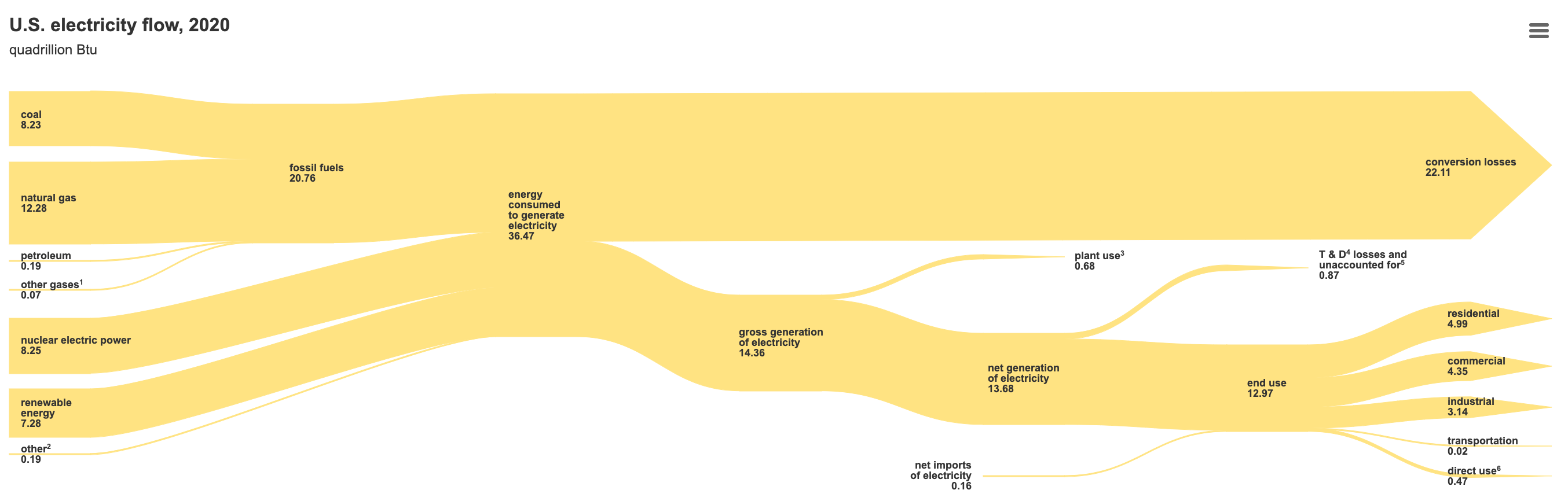
If we are serious about decarbonization and want to get rid of coal for instance, a combination of hydrogen, geothermal, and nuclear could be an environmentally friendly alternative for the balance of our energy. Hydrogen and geothermal are both currently seeing massive investment to catalyze progress. However, Nuclear is seeing less investment and is in fact dwindling as a share of the US national grid energy mix.
The nation’s fleet of reactors is down to 94 as of August 2020. Since 2013, 11 reactors have shut down and another eight are scheduled to close by 2025. If the trend continues, we will lose more than 10% of the nation’s nuclear capacity within the decade. That’s a big deal considering nuclear power produces nearly 20% of America’s power and more than 50% of its clean energy as it currently stands. Shuttering nuclear plants is completely unhelpful in our effort to decarbonize. 2
So why the shift away from nuclear? Nuclear fission is what we are referring to when we talk about nuclear power. Fission is the process of splitting a dense element (such as uranium or plutonium in half). It causes a massive reaction and is highly radioactive long after, causing logistical issues for waste disposal, and of course, huge risks should the plant become compromised. Fear around worst case scenarios is part of the reason we’ve continued to close plants. The Diablo Canyon nuclear plant in California is a good example of fear driving decision making. Diablo produces 10% of the state's energy and is scheduled to be decommissioned even though all studies point to it being a huge mistake for a state already struggling with its grid. Yet, in two years, Diablo will be shut down over concerns around proximity to a fault line.
The other issue with fission is economics. These reactors are incredibly costly to build (~6 to 9b) and almost always have longer construction times (5 to 7y). It doesn’t seem as though we have enough expertise or construction know-how to be confident in building our nuclear infrastructure. These challenges could likely be solved through collaboration with foreign countries (France) or through government investment, but this is the current state of affairs. There are a host of companies that are working to change the economics around fission by creating smaller, modular reactors. Oklo is an example of a new age nuclear company trying to bring a new approach to Nuclear power. Yet there’s another option to fission - fusion. We haven’t been able to figure it out just yet, but we’re getting closer.
Nuclear Fusion
The energy savior needs to hurry up
Enter, Nuclear Fusion, the elusive form of nuclear energy that humans have longed for almost 75 years. Fusion is the magic behind the power of the sun. Instead of splitting an atom, two small atoms (like hydrogen) are merged making a larger one, creating huge amounts of energy in the process. Fusion is emission free, has no nuclear waste, and can create enough energy to power an entire city, or state. If we solve fusion, it will likely become the “savior” (as the New Yorker put it3) for managing our energy demands without emissions.
Yet we still have major challenges to getting fusion energy operational. Fusion happens when the reaction is heated to more than a hundred million degrees. First, we need to be able to create a reaction of that intensity - which requires speeding up the molecules to such a degree that the reaction can become a self-sustaining plasma (like the sun). This part is actually more of a known element since we’ve been experimenting with particle acceleration for decades now. The more elusive aspect is figuring out a way to harness and contain the 100 million degree reaction without melting everything in its vicinity.
Because the particles inside the reaction have an electric charge, in theory you can use magnets to suspend it and prevent contact with anything solid. Recent innovations in material science at MIT have brought forward new high-temperature superconductors that can handle such extremes. Superconductors offer little to no resistance to the flow of electricity which makes them ideal for magnets. They also lose almost no heat—helpful for harnessing energy. We’re moving closer to having all the elements of a successful fusion reaction, now we just need to pull everything together.
The most widely used configuration for doing so is a donut-shaped device called a tokamak4. The term "tokamak" comes from a Russian acronym that stands for "toroidal chamber with magnetic coils." The tokamak is designed to harness the energy of a fusion reaction. Inside a tokamak, the energy produced through the fusion of atoms is absorbed as heat in the walls of the vessel. Just like a conventional power plant, this heat produces steam and then electricity by way of turbines and generators5.
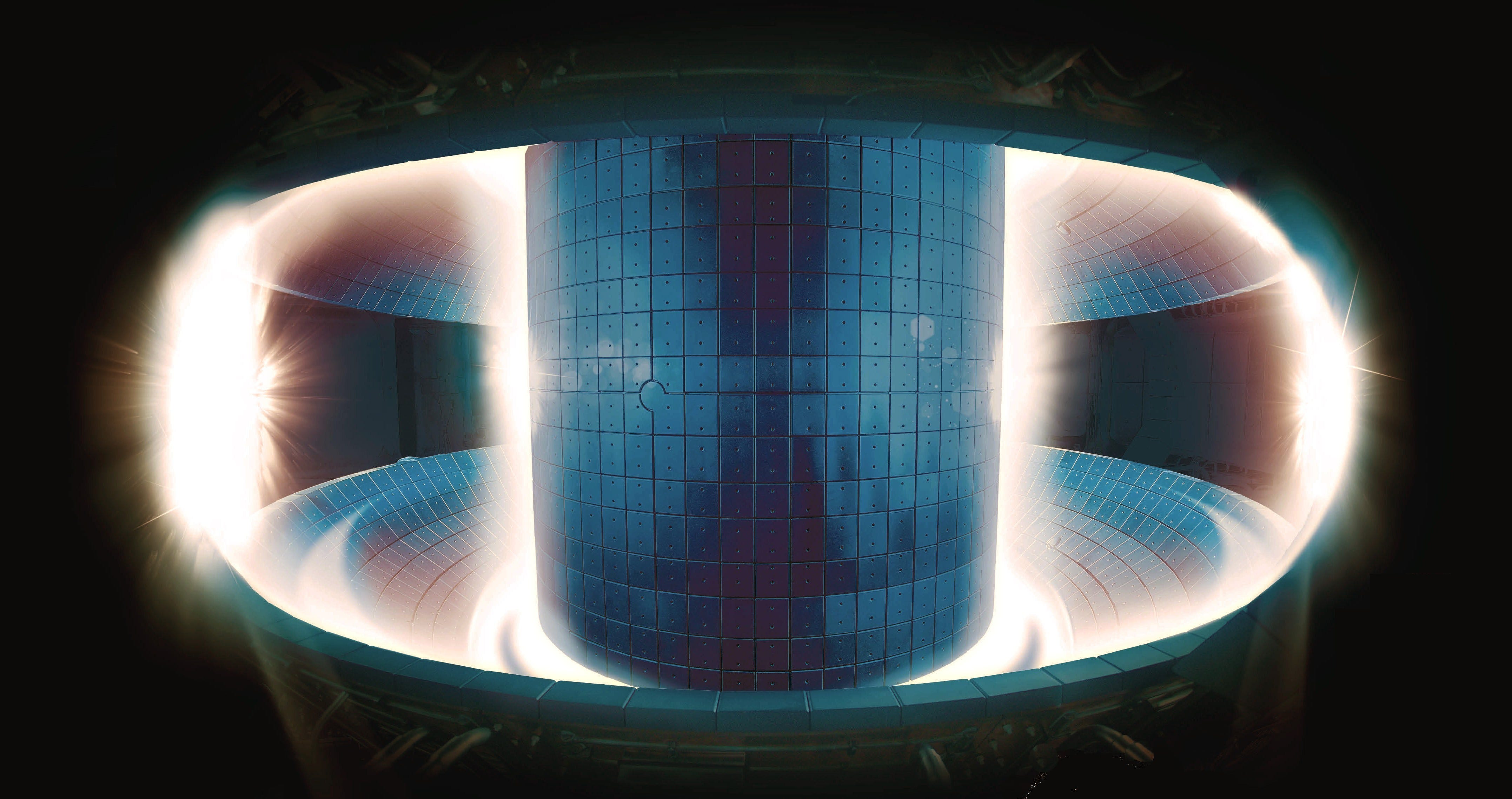
The most promising tokamak project in development is ITER - an international collaboration between 35 countries which is under construction in France. It’s been in development for 35 years now and hopes to achieve its goal of a 500MW reaction by 2035. It’s likely the most ambitious collaboration since the International Space Station. There are also private companies working on fusion as well - Commonwealth Fusion Systems is a Boston based endeavor which has had recent success with it’s magnet testing thanks to it’s close ties to MIT6. In fact, just this past week, CFS announced it had raised an additional $1.6B of funding from the whose who of climate tech investors. This should be hugely helpful for advancing their goals.
Fusion still has a ways to go before it can become a legitimate part of our energy system. We should all be excited about the technological progress to date considering how technically challenging this project is. If fusion ends up working, it could be a complete game changer for how we generate electricity and allow us rapidly decarbonize our grid.
We should have much of the same excitement for fission as well. Nuclear power is one of the most amazing technologies humans have made. Watching the US turn its back on nuclear is disappointing, especially while other countries have started to put more in. If you’ve made it to this point - I hope that you will join me as a pro-nuclear salesperson amongst your friends. And use the word Tokamak in conversation this week.
https://www.economist.com/science-and-technology/servicing-and-repairing-electric-cars-requires-new-skills/21805752
https://www.energy.gov/ne/articles/could-hydrogen-help-save-nuclear